Necessary Seeds and others things in summer for Love birds
Wednesday, 20 May 2015
Love Bird Care
HOUSING:
Lovebirds need a cage which has at least two places to perch, with room to fly from one to the other. A cage with a horizontal measurement of 24 inches to 30 inches is appropriate. Anything less than 18 inches would be too small and restrictive. Perches need to be a size which is comfortable for the birds feet, not too small or too large.
It is convenient to have two sets of food and water dishes so that they can be alternated and washed each day. Water must be changed and the dish washed every day. Food dishes can stay longer, with food added each day if preferred, but food dishes do need to be completely emptied, washed, and refilled at least once a week. Caution -- food dishes sometimes look full, but only have seed hulls and waste in them, with no good food for the bird!
Lovebirds need activity in the cage to stay healthy. Swings, ladders, and interlocked bamboo rings are favorites. The 6 inch cockatiel swings are the best size for lovebirds. Pet departments or stores have many choices in toys for pet birds. Avoid small toys designed for parakeets and budgies. Lovebirds have very strong beaks for chewing and can break these items. Toys designed for cockatiels and small parrots are the right size for lovebirds.
FOOD:
Lovebirds need the same size food as cockatiels and other small parrots. If you plan to feed your birds a seed mix, choose one which contains nutritional supplements to assure a "total diet" to keep birds healthy. Other less expensive seed mixes, or seeds sold for wild birds will not have all the nutrients your bird needs, although they can also be used if you provide lots of fresh foods. Note --pellet diets like Kaytee Exact or Pretty Bird are nutritionally complete and very good for birds, though some birds will be slow to accept them. Birds that are used to seeds will need to be given adequate time to adjust and learn to eat a pellet-only diet.
Try to give fresh foods at least 3 or 4 times a week. Our birds love apples, broccoli, cabbage, kale, carrots, parsley, and spinach. You can try other vegetables and fruits, too. Lettuce is okay, but it doesn’t have much nutritional value. In the summer we sometimes give dandelion and clover (flowers and greens) from the yard. Make sure to wash off any pesticides or chemicals which could hurt the bird. Our birds also like corn tortillas (not salted tortilla chips) and whole grain breads. Don’t feed anything with high fat, salt, or sugar content, like donuts, cake, or cookies. Caution -- remember to remove any uneaten fresh food from the cage before it spoils.
Try to keep cuttlebone in the cage all the time to provide calcium for the bird. Millet sprays, sometimes called "seed trees" are a good treat.
Lovebirds need a cage which has at least two places to perch, with room to fly from one to the other. A cage with a horizontal measurement of 24 inches to 30 inches is appropriate. Anything less than 18 inches would be too small and restrictive. Perches need to be a size which is comfortable for the birds feet, not too small or too large.
It is convenient to have two sets of food and water dishes so that they can be alternated and washed each day. Water must be changed and the dish washed every day. Food dishes can stay longer, with food added each day if preferred, but food dishes do need to be completely emptied, washed, and refilled at least once a week. Caution -- food dishes sometimes look full, but only have seed hulls and waste in them, with no good food for the bird!
Lovebirds need activity in the cage to stay healthy. Swings, ladders, and interlocked bamboo rings are favorites. The 6 inch cockatiel swings are the best size for lovebirds. Pet departments or stores have many choices in toys for pet birds. Avoid small toys designed for parakeets and budgies. Lovebirds have very strong beaks for chewing and can break these items. Toys designed for cockatiels and small parrots are the right size for lovebirds.
FOOD:
Lovebirds need the same size food as cockatiels and other small parrots. If you plan to feed your birds a seed mix, choose one which contains nutritional supplements to assure a "total diet" to keep birds healthy. Other less expensive seed mixes, or seeds sold for wild birds will not have all the nutrients your bird needs, although they can also be used if you provide lots of fresh foods. Note --pellet diets like Kaytee Exact or Pretty Bird are nutritionally complete and very good for birds, though some birds will be slow to accept them. Birds that are used to seeds will need to be given adequate time to adjust and learn to eat a pellet-only diet.
Try to give fresh foods at least 3 or 4 times a week. Our birds love apples, broccoli, cabbage, kale, carrots, parsley, and spinach. You can try other vegetables and fruits, too. Lettuce is okay, but it doesn’t have much nutritional value. In the summer we sometimes give dandelion and clover (flowers and greens) from the yard. Make sure to wash off any pesticides or chemicals which could hurt the bird. Our birds also like corn tortillas (not salted tortilla chips) and whole grain breads. Don’t feed anything with high fat, salt, or sugar content, like donuts, cake, or cookies. Caution -- remember to remove any uneaten fresh food from the cage before it spoils.
Try to keep cuttlebone in the cage all the time to provide calcium for the bird. Millet sprays, sometimes called "seed trees" are a good treat.
Fisher's Mutations
Fisher’s
Mutations: Albino, Lutino, Yellow, White
Fischer’s lovebirds are a completely
different species from Peachfaces. These birds also come in a variety of
colors, from the wild-type green to the dramatic lutino and captivating albino.
Tequila and Tundra
I have found these birds to be
extremely gentle, even if they haven’t been handled regularly. If you want a
pet it is still best to get a handfed baby that has been well-socialized.
However, I have found many Fischer’s easier to tame again if they’ve been
allowed to “go wild,” unlike most peachfaces.
Lutino and albino mutations
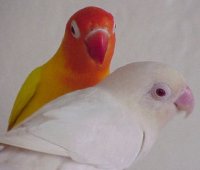
Tundra (albino) and Tequila (lutino)
are stunning Fischer’s lovebirds – nicknamed TnT!
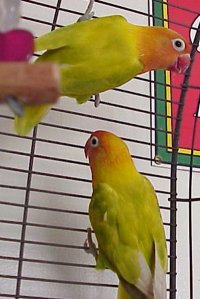
Yellow Fischers (Green Series –
Split Ino)
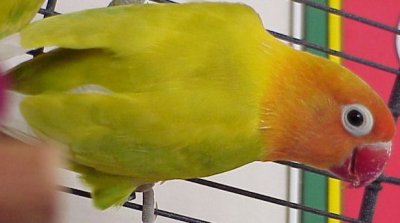
Yellow Mutation
Yellow mutation
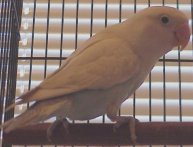
White Mutation
White mutation of Fischer's lovebird
Breeding
Breeding
Black-masked lovebirds can start breeding when they are as young as ten months of age and may continue until they are five to six years. They are very prolific and may produce several egg clutches within a single year. Due to this, they are usually readily available on the pet market.
During breeding season the behavior between partners will change: the male displays a more aggressive behavior, while the female begins preparing the nest. There are specific nesting boxes for lovebird-size birds, but if not available a cockatiel nesting box will do just fine. Samples of available nest boxes.
The nests are almost entirely made by the females and the three to six eggs are incubated for about twenty-three days. The hatchlings will be cared for by the female until they leave the nest at about six weeks of age. The father then takes over the feeding of the young birds for another two weeks or so until they are weaned.
- Comprehensive resource on breeding lovebirds
Training and Behavioral Guidance:
Lovebirds are pretty easy to manage for most people. They are not as
destructive and noisy as their larger cousins. If not properly
socialized, however, they will discover their beaks as method of
"disciplining us".
It really is important to learn to understand them and to guide their
behavior before an undesirable behavior has been established. There are
few things to consider ...
- Biting: If not properly socialized, however, they will discover their beaks as method of "disciplining us". They can be very aggressive towards other animals (including birds), if they don't know them or are jealous of the attention they are getting from their favorite human.
- Noise: Lovebirds are very vocal birds, making loud, high-pitched noises that can be a nuisance. They make noise all day, but especially at certain times of day.
- Chewing: As stated above, lovebirds are also very active, and love to chew things. When they are let out of their cage, it would be wise to watch them carefully, and protect any furniture, electrical wiring or anything else that they could possibly chew on. They are not big chewers - as their preferred medium is "paper."
- Paper: They love to tear up paper -- especially when they are in the "mating" spirit -- which is all-year-round for birds kept indoors (not exposed to the seasons). I have learned not to keep important papers laying around - and even use it as a way to keep my lovebird busy.
Training and behavioral guidance is recommended ...
- AvianWeb Resources: I put together web resources for you to help you understand your pet bird and properly direct him. Please visit the following website to learn more about parrot behavior and training. If you found a way to resolve a "parrot behavioral issue" please share it with others.
Masked Love Birds
Distribution and Habitat:
Masked Lovebirds aka Black-masked Lovebirds or Yellow-collared Lovebirds (Agapornis personatus) are small, stocky African parrots that are native to the inland plateaus of northern and central Tanzania in light brushwood and trees. Some flocks can also be found in north-east Kenya and in the coastal areas of Tanzania.
The Masked Lovebird were discovered in the late 1800s - but were not imported until the 1920's. The blue mutation also occurred in the wild, and was imported soon after its introduction.These lovebirds are social creatures that form small nesting colonies in the wild. In captivity, they do best in an aviary setting. They are not happy in solitary confinement situations. They either need plenty of human attention or a mate.Black-masked lovebirds, and the many color variations that have been produced in captivity, are very popular in the pet trade and are now some of the most common pet birds in America and Europe.The Masked Lovebirds are frequently named by their body color - rather than the mask color; such as green-masked lovebirds, blue-masked lovebirds, violet-masked lovebirds, etc.
Description (Normal Green Masked Lovebird):
Masked lovebirds average 6 inches or 14.5 cm in length. The naturally occurring masked lovebirds have a green body color. The head is mostly black and the color of its plumage is except for a few highlights green with a yellow collar. However, other mutations -- specifically blue and yellow -- have been bred in captivity.
- Sexing / Gender Identification: Males and females look alike in appearance - although hens are usually larger in size, and may have a smaller, more rounded head.
- Plumage:
- The body, abdomen and under-tail coverts of the normal / naturally-occurring black-masked lovebirds are yellowish–green. The rump is greyish blue.
- The under-wing coverts are grey-blue. The upperside of the wings is dark green, the underside is lighter. The flight feathers are black.
- The forehead, lores (the regions between the eyes and bill on the side of a bird's head), cheeks and the part under the bill is brown-black. The back of head is a dirty olive.
- The breast and one part of throat is yellow. On most of them orange-red feathers can be seen on the upper chest.
- The tail is green and the outer tail feathers are edged with an orange-yellow band.
- Eyes: White ring encircles both eyes. The irises are brown. Beak is redLegs and feet are grey
- Hybrids between Fischer's Lovebirds and Masked Lovebirds are also quote common in captivity and have also occurred in feral populations. They are reddish-brown on the head and orange on the upper chest, but otherwise resemble the Masked Lovebird.
Besides the normal green coloration, there are several striking mutations:
-
- blue-mutation (referred to as "Blue Masked Lovebirds - blue describing the body color, rather than the mask color. The mask is black - as it is in the normal green color)
- yellow
- albino
Subscribe to:
Comments (Atom)